


Solar Information and FAQs
BRMEMC is committed to helping our members learn more about solar and understand emerging energy technology like solar, electric vehicles, and battery storage. The information found below and in the FAQs section can assist members in making the best decisions for their solar needs and possibly save thousands of dollars on a solar installation.
Thinking about installing a solar system at your house?
Here are a few things you'll want to do and know before signing a solar contract:
CONTACT YOUR INSURANCE PROVIDER
The first thing you’ll want to do is contact your homeowner’s insurance provider. Find out if they cover adding solar to your home and if there will be any additional costs.
TALK WITH YOUR CPA OR TAX ADVISOR
Talk with your CPA or tax advisor regarding the solar tax credit. Tax credits are often confused with a solar rebate. Your tax advisor can provide you a better idea of how much a tax credit benefits your situation.
FIND OUT THE AGE AND CONDITION OF YOUR ROOF
Find out the age and condition of your roof materials. You’ll want to avoid putting a new solar system on your roof if it needs to be repaired or replaced. Replacing your roof after installing solar panels requires you to remove them, and this cost is not accounted for most break-even projections.
CONTACT YOUR COUNTY AGENCY
It's very important to speak with your county agency regarding electrical inspections and any other inspections they require.
RESEARCH SOLAR VENDORS
Research each vendor you think about using. Check the vendor’s reviews on SolarReviews.com, BBB reviews, and Google Reviews. Reviews are often more telling than the companies rating. Also, be sure to ask the solar vendor if they've worked on other projects in the area and ask them for references. If you have a question about quality solar contractors, call BRMEMC to discuss your concerns or get a recommendation.
GET AT LEAST 3 QUOTES
Get a minimum of three quotes. While the first offer you get may be the best, you’ll want to get a couple of other offers to compare. You should feel confident you’re getting the best deal for you.
SLEEP ON IT
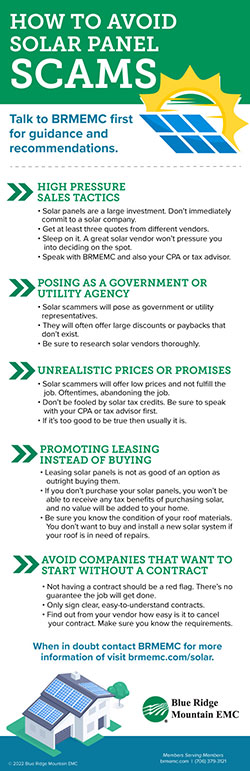
Don’t give in to high-pressure sales tactics. A great solar vendor won’t pressure you into deciding on the spot. They know and understand that a decision of this cost takes time and thought.
CAN YOU CANCEL EASILY?
Find out from your vendor how easy is it to cancel your contract. Make sure you know their requirements. Typically, you will have three days to cancel after you’ve signed the contract. If you are still in your window to cancel and are unsure about it cancel the contract. You can always sign a new contract after you've given the process more thought.
GET YOUR DATA
Typically, contractors will ask you to request some data from your utility. A good contractor is going to ask you to get the last 12 months of hourly data. If a contractor asks you to only get your monthly bills for the past 12 months, you should move forward with caution. If you need to get your hourly data, call BRMEMC and speak with our Member Services department.
MEMBER FEES
We are a very solar-friendly utility. BRMEMC charges and fees are listed below per Policy 336.
- Interconnection Application Fee = $500.00 per installation (Plus $10.00 per kW)
- Labor, Transportation, and etc. = $200.00 per trip
- Construction Charges (if applicable) = Actual Cost
- Metering:
- Class 200/320 A Single Phase Meter = $100.00
- Class 200/320 A Three Phase Meter = $350.00
- Class 20 CT Rated Meter = $350.00
- Class 20 CT Rated Meter (RS232 Output) = $750.00
- Additional items needed for metering will be included in the Construction Charges
- Meter Communication
- Any applicable meter communications fees required by TVA will be the responsibility of the member.
FREQUENTLY ASKED QUESTIONS
BRMEMC FAQs
No, Blue Ridge Mountain EMC does not install PV systems. You will need to select a solar contractor and they will submit all paperwork to BRMEMC Energy Service Technician Craig Shook to begin the process.
No, we use bi-lateral metering. Any generation will not be credited back to the customer.
BRMEMC Energy Service Technician Craig Shook
(706) 379-3121, ext. 189
craig.shook@brmemc.com
Click here for the BRMEMC Interconnection Agreement.
Energy Production Questions
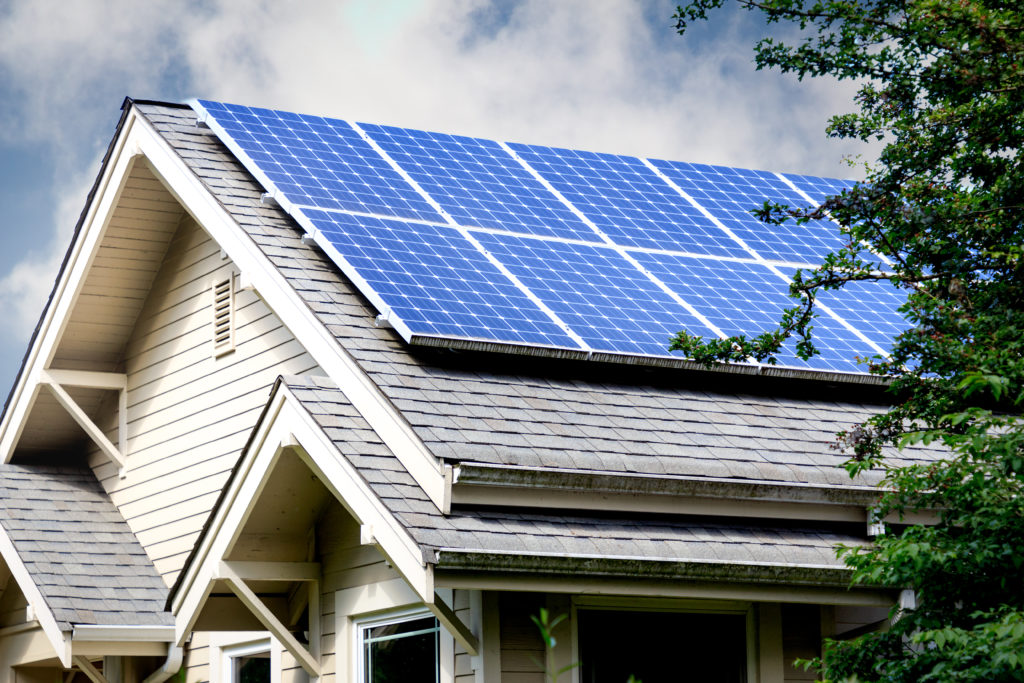
Photovoltaic (PV) systems generate solar energy using semiconductor cells to convert sunlight into electricity. PV systems contain solar panels to absorb and convert sunlight and inverters to change direct current (DC) into alternating current (AC). AC is the standard electrical power that we use in our homes and businesses. PV cells connect into solar panels mounted in an orientation to take the most advantage of the sun. That can be on rooftops, canopies, the ground, or integrated into roofing shingles or other building materials.
No. Depending on the season, a PV system typically generates power from 8 a.m. to 6 p.m., reaching its maximum output between noon and 1 p.m. when the sun is at its peak. When PV systems are not producing power, Blue Ridge Mountain EMC and TVA provide other resources to deliver reliable electricity to homes and businesses.
Yes. However, a PV system generates less electricity when the weather is cloudy. A PV system might receive only 5 to 10 percent of the usual amount of sunlight on an overcast day, so the power output decreases proportionately.
Solar panels vary in size, wattage, and technology. A typical solar panel produces 250 watts of electricity and measures 3.25 ft x 5.4 ft, or about 17.5 sq ft. A 5-kW solar system requires around 400 sq. ft. of usable south/south-west facing roof area by applying typical solar panel specifications. This includes additional space to comply with fire safety standards.
PV systems generate more power at lower temperatures. Like most electronic devices, they operate more efficiently when it’s cooler. PV systems generate less energy in the winter than in the summer, but that’s due to the combination of fewer daylight hours and lower angles of the sun, not to cooler temperatures.
Many factors can affect the efficiency of your solar panels. These include:
- The shading on your house
- The orientation and tilt of your solar panels
- How many sunlight hours your house receives during the day
- The quality of your inverter
- The temperature
Any combination of these factors can significantly impact the amount of solar energy your panels generate.
Financial Questions
ITC is the Federal Investment Tax Credit (ITC) Program issued by the government to support solar energy development in the United States. The ITC is a tax credit and not a tax rebate — before buying a solar PV system, check with your tax professionals about the implications ITC has on your finances.
In addition to the ITC and accelerated depreciation (for commercial members), there are varying rebate and incentive offers, depending on the state where you live. Contact your solar vendor to get the latest information on solar rebates and incentives.
The time to recover the cost of your solar system installation can vary significantly based on several factors. With the current rate structures and incentives provided, an average residential solar system in the Tennessee Valley is about 10 kW and requires at least 26 years to pay off even with the ITC applied. Some members may not break even on their installation depending on their energy usage, PV system size, and maintenance costs.
The Modified Accelerated Cost Recovery System (MACRS) is a tax advantage mechanism that allows commercial members to accelerate depreciation of their solar investment over 5 years and thereby reduce their tax burden. This can result in a quicker return on investment for applicable commercial members.
Yes. You can set up personal financing for your solar system installation through your bank or preferred loan company. Your interest rate and loan terms impact your return on investment. If you decide to finance your solar PV system, we recommend shopping around to find the best interest rate and loan terms for your situation.
Maintenance & Ownership Questions
A typical solar system has a useful lifespan of 25 to 30 years, depending on the local environment and the system's durability. After this period, your solar panels will continue to generate electricity but at a lower efficiency.
Solar inverters have a typical lifespan of around 10-12 years, and you can expect to replace them at least once over the lifespan of a solar system.
PV systems typically have two types of warranties provided by panel manufacturers: a product warranty and a performance warranty. The product warranty usually covers 10-12 years of manufacturing defects, wear and tear, and environmental issues of the panels. Since panels become less efficient over time, the performance warranty guarantees a certain amount of solar production for up to 25 years. You can expect to get 90% of the advertised production for the first 10 years and 80% production until the system is 25 years old.
A solar inverter warranty should be a significant consideration when purchasing a system. Warranties may vary widely by manufacturer, so please contact your solar installer for specific warranty details.
Solar panels generally don’t require much ongoing maintenance throughout the system's lifespan, as there are no moving parts like tracking systems. However, inverters and other connected components may require periodic maintenance or inspection. BRMEMC recommends annual routine inspections, cleaning and maintenance to ensure your system functions properly and efficiently.
Click the infographic below to learn how to avoid solar panel scams.
Member Services
875 Main Street East
Young Harris, Georgia 30582
P.O. Box 9
Young Harris, Georgia 30582
(706) 379-3121
"As soon as we got home, we heard a transformer blow. Within 30 minutes BREMC was out here and within another 30 they restored our power. Cannot thank these men and women enough for the jobs they do. Especially when it’s late at night and raining in 36 degree weather."
Seth
"Thanks for everything you do keeping thousands of customers in power, especially during all the snow and cold and rain. You guys are great!"
Gail
"Thanks for all the hard work!! Great job everybody!"
Michael
"Thank you for AWESOME response times and excellent service. The linemen went above and beyond!"